Gallery 44
William Henry Holmes | Trundling Along Kancamagus Highway, New Hampshire
William Henry Holmes | Trundling Along Kancamagus Highway, New Hampshire
Inquire For Price
Share
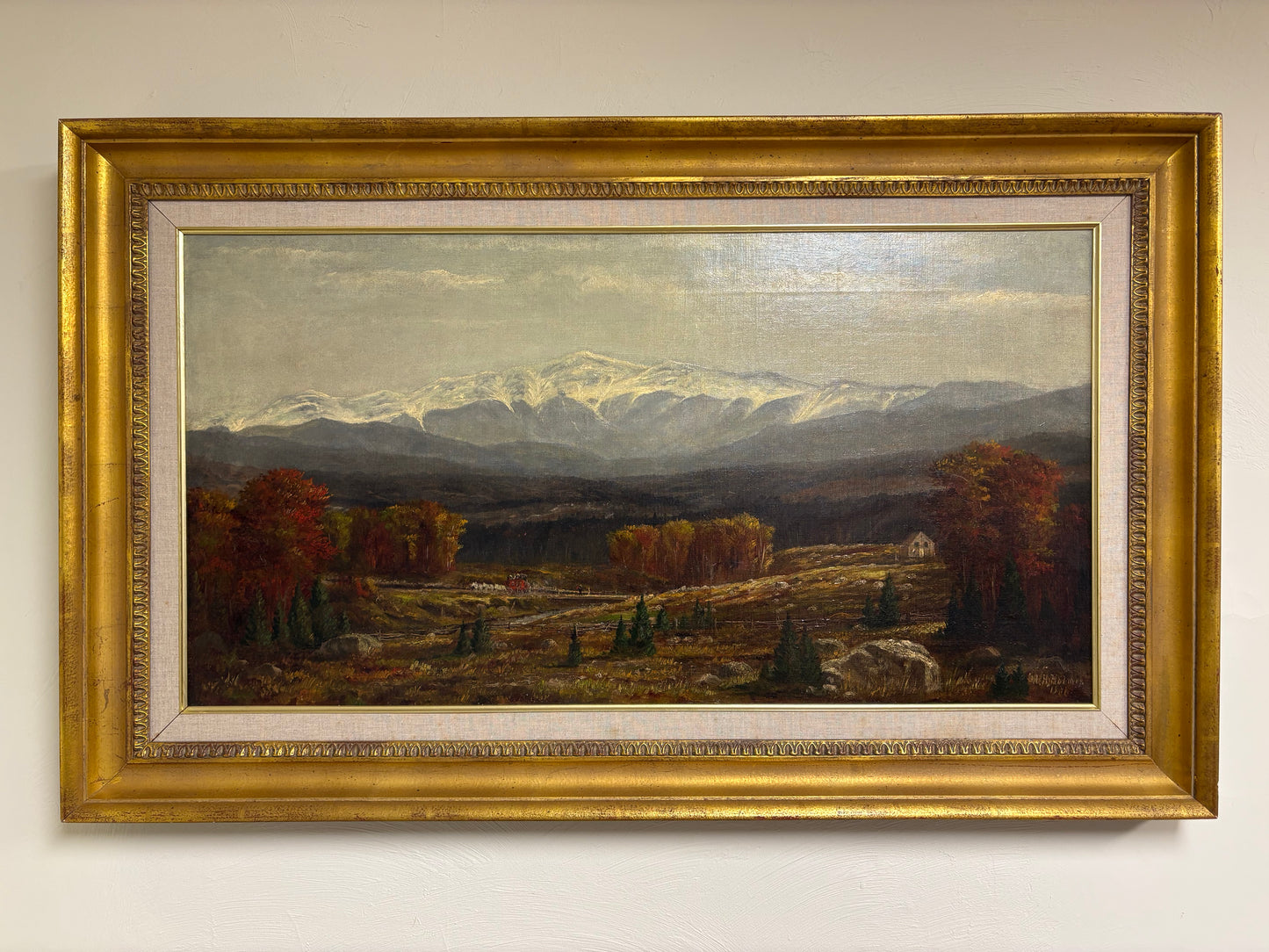
This oil on canvas by William Henry Holmes, titled Trundling Along Kancamagus Highway, New Hampshire and dated 1881, presents a beautiful panoramic view of the New England countryside at the height of the autumn season. Brilliant fall foliage spreads across the landscape in rich seasonal tones, while the mountains of New Hampshire rise majestically in the distance, their highest peaks touched with snow. The broad horizontal format, measuring 18 x 34 inches, allows Holmes to create an expansive sense of space, carrying the viewer from the colorful foreground through the rolling countryside to the distant mountain range.
The composition combines the warmth and familiarity of a traditional New England landscape with the grandeur of the surrounding mountains. Holmes’s careful observation of topography and natural detail is evident throughout the scene, from the changing autumn foliage to the distant snow-capped peaks. Painted in 1881, the work captures both the picturesque beauty and impressive scale of the New Hampshire landscape, reflecting the artist’s lifelong fascination with the relationship between geology, geography, and the natural world.
Signed by the artist in the lower right corner.
Dated 1881.
Oil on canvas.
Size: 18 x 34 inches.
William Henry Holmes (1846–1933) was a remarkable American artist, scientific illustrator, geologist, explorer, archaeologist, anthropologist, and museum director whose career brought together the worlds of art and science. Born in Ohio, Holmes moved to Washington, D.C., in 1871 to study art under Theodor Kaufmann. His exceptional ability as a draftsman soon brought him to the attention of scientists at the Smithsonian Institution, where he began producing highly detailed scientific illustrations.
In 1872, Holmes joined the celebrated Hayden Geological Survey as an artist and topographer, traveling through Yellowstone, Wyoming, Colorado, and other regions of the American West. During these expeditions, he worked in an environment that also included such important nineteenth-century figures as photographer William Henry Jackson and artist Thomas Moran. Holmes became particularly renowned for panoramic landscapes that combined artistic sensitivity with extraordinary geographical and geological accuracy. In 1880, immediately preceding the date of this painting, he worked with geologist Clarence Dutton, producing important topographical drawings of the Grand Canyon region.
Holmes went on to have one of the most varied careers of any American artist of his generation. In addition to painting, he became a respected archaeologist and anthropologist and held important positions at the Field Columbian Museum in Chicago and the Smithsonian Institution in Washington. In 1920, he became director of the Smithsonian’s National Gallery of Art, the institution now known as the Smithsonian American Art Museum, remaining in that position until his retirement in 1932. His works and extensive archival materials remain preserved within the Smithsonian, reflecting his extraordinary contributions to American art, exploration, science, and museum scholarship.
Painted in 1881, Trundling Along Kancamagus Highway, New Hampshire is an appealing example of Holmes’s landscape work, combining brilliant New England autumn color, distant snow-covered mountains, and carefully observed terrain. Its unusually broad format further emphasizes the panoramic quality for which Holmes became known and demonstrates the distinctive union of artistic vision and close observation of the natural world that characterized his remarkable career.