Gallery 44
J. Alden Weir | Roses
J. Alden Weir | Roses
Inquire For Price
Share
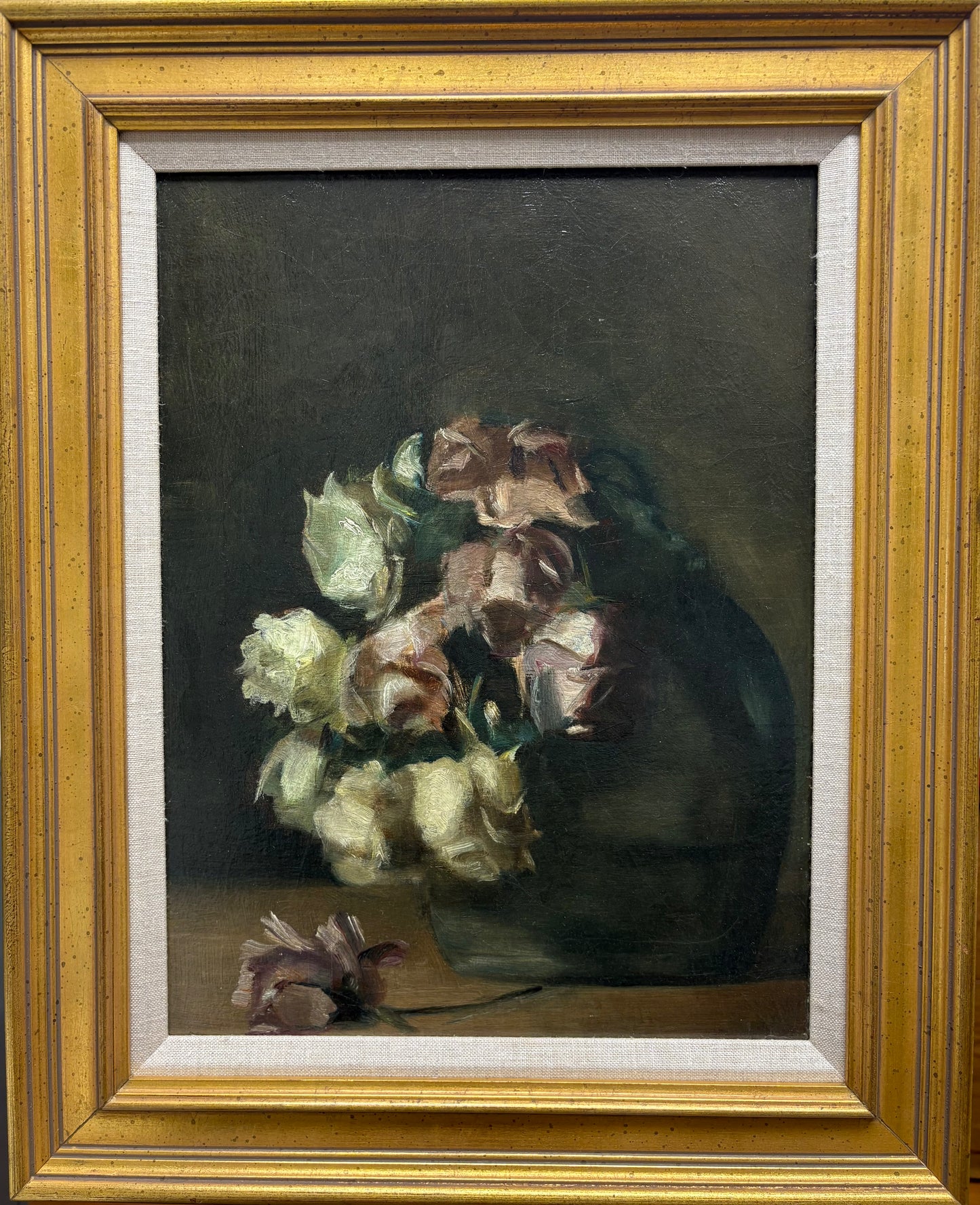
This intimate oil on canvas, attributed to J. Alden Weir, depicts a loosely arranged bouquet of roses emerging dramatically from a dark, almost monochromatic background. Creamy white, pale yellow, dusty pink, and muted rose-colored blossoms are gathered in a dark vessel, their softly illuminated petals providing the principal areas of light within the composition. A single fallen flower rests upon the tabletop in the foreground, separated from the bouquet and lending the still life a quiet, contemplative quality.
Measuring 12 x 16 inches, Roses is particularly effective in its restrained palette and economical handling of paint. Rather than describing every petal with botanical precision, the artist builds the flowers with broad, confident strokes and touches of light, allowing individual blossoms to emerge gradually from the surrounding darkness. Deep greens in the foliage and vase merge almost completely with the background, focusing attention on the pale roses and creating a strong sense of depth and atmosphere.
The painting's subdued tonal range and dark ground are especially noteworthy in relation to Weir's work of the 1880s. During this period, before fully embracing the brighter palette associated with his later American Impressionist landscapes, Weir devoted considerable attention to portraits, figure paintings, and intimate still lifes executed in darker tonal harmonies. The Metropolitan Museum of Art's Fruit, circa 1888, is a documented example of this aspect of his career.
Attributed to J. Alden Weir (1852–1919).
Oil on canvas.
Size: 12 x 16 inches.
Unsigned.
Circa 1880–1890.
Julian Alden Weir (1852–1919) was one of the most important figures in the development of American Impressionism. Born at West Point, New York, into a distinguished artistic family, Weir received early instruction from his father, Robert Walter Weir, professor of drawing at the United States Military Academy. He studied at the National Academy of Design before traveling to Paris in 1873, where he attended the École des Beaux-Arts and studied under celebrated French academic painter Jean-Léon Gérôme. He remained in Europe until 1877, traveling through France, Holland, Belgium, Spain, and Brittany and exhibiting at the Paris Salon.
After returning to New York, Weir established himself initially as a portrait and still-life painter and taught at the Art Students League. During the 1880s he produced figure paintings and still lifes characterized by relatively dark, restrained palettes. His artistic direction gradually changed after further exposure to contemporary French painting, and by the 1890s he had developed the softly luminous landscapes for which he is now particularly celebrated.
Weir became a central figure in the American art establishment. He was elected a full National Academician in 1886and in 1897 helped form The Ten American Painters, the influential group that also included artists such as Childe Hassam and John Henry Twachtman. He later served as president of the National Academy of Design and on the board of the Metropolitan Museum of Art. His Connecticut home and studio are preserved today as Weir Farm National Historical Park, the only National Park Service site devoted specifically to American painting.
Weir's paintings are represented in major American museum collections, including The Metropolitan Museum of Artand the Smithsonian American Art Museum. His papers are preserved by the Smithsonian's Archives of American Art, providing extensive documentation of his career and his relationships with many of the leading American artists and collectors of his generation.
With its dark tonal palette, loosely handled blossoms, restrained composition, and intimate scale, Roses bears characteristics worthy of comparison with the still-life work Weir produced during the 1880s. Until further documentation or scholarly authentication becomes available, however, the painting is appropriately presented as Attributed to J. Alden Weir.