Gallery 44
Henry Golden Dearth | The Lowlands
Henry Golden Dearth | The Lowlands
Inquire For Price
Share
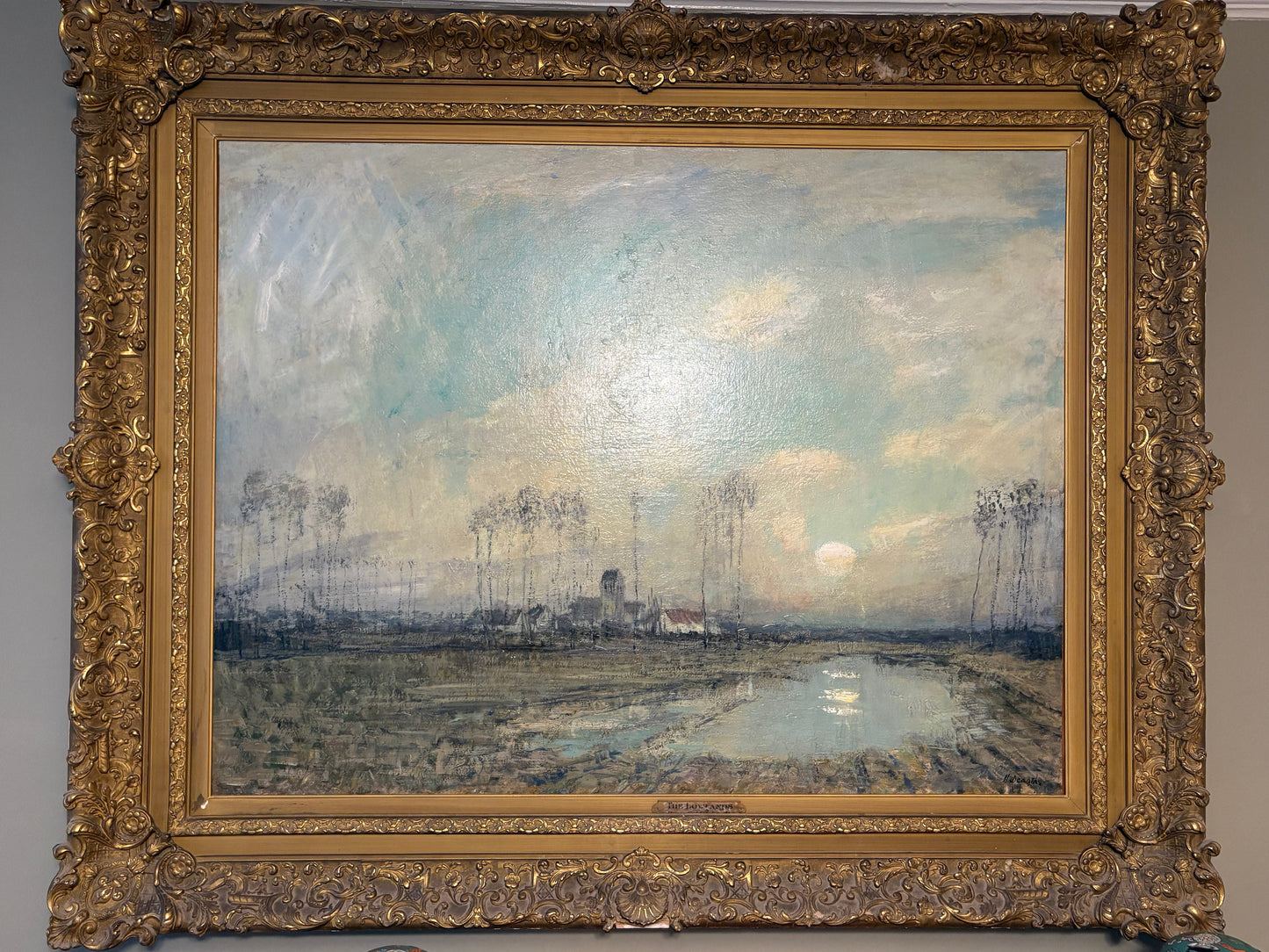
This oil on canvas by Henry Golden Dearth, titled The Lowlands, presents an expansive and deeply atmospheric landscape believed to depict the lowlands of Normandy in northern France. Across a broad, marsh-like plain, a narrow body of still water reflects the subdued light of the sky, while a small cluster of distant buildings and slender trees marks the low horizon. Above, an immense luminous sky dominates the composition, its softly modulated clouds surrounding a pale setting sun or moon and bathing the countryside in a quiet, diffused glow.
Measuring an impressive 34 x 45 inches, the painting is particularly striking for Dearth's use of scale and atmosphere. The low horizon allows the sky to occupy much of the canvas, emphasizing the openness and solitude of the landscape. Earthy browns and muted greens in the foreground gradually give way to delicate blues, grays, and warm touches of light above. Reflections in the water provide a subtle point of illumination within the otherwise restrained palette. The sparse trees, distant settlement, marshy terrain, and hazy light combine to create the contemplative, almost dreamlike mood for which Dearth's Tonalist landscapes are admired.
Signed by the artist in the lower right corner.
Oil on canvas.
Size: 34 x 45 inches.
Believed to depict the lowlands of Normandy, France.
Henry Golden Dearth (1864–1918) was a distinguished American landscape painter associated with Tonalism and the American Barbizon tradition. Born in Bristol, Rhode Island, Dearth traveled to Paris in 1883, studying at the École des Beaux-Arts with Ernest Hébert and privately with Aimé Morot. He first exhibited at the National Academy of Design in 1888, followed by the Society of American Artists the following year. For much of his career, Dearth maintained a studio at Montreuil-sur-Mer in Pas-de-Calais, near the English Channel, where the landscape of northern France became an important source of inspiration.
Dearth became particularly admired for poetic landscapes depicting Normandy and Brittany, as well as Long Island, frequently choosing twilight, moonlight, and other atmospheric conditions that allowed him to explore subtle variations of tone and light. His early landscapes are characterized by subdued palettes, low tonal values, richly worked surfaces, and a quiet, meditative quality. In 1893, he received the prestigious Webb Prize from the Society of American Artists, followed by a bronze medal at the Paris Exposition Universelle of 1900 and a silver medal at the Pan-American Exposition in Buffalo in 1901.
Dearth's work is represented in important American museum collections, including the National Gallery of Art, Smithsonian American Art Museum, and Detroit Institute of Arts. The Smithsonian's An Old Church at Montreuil, circa 1906–1907, documents his sustained fascination with the landscape surrounding his French home and studio.
With its expansive sky, distant settlement, reflective water, and subdued lowland terrain, The Lowlands is a particularly evocative example of Dearth's Tonalist approach to landscape painting, transforming an understated rural scene into a study of light, atmosphere, and stillness.