Gallery 44
Granville Perkins | Central American Scene
Granville Perkins | Central American Scene
Inquire For Price
Share
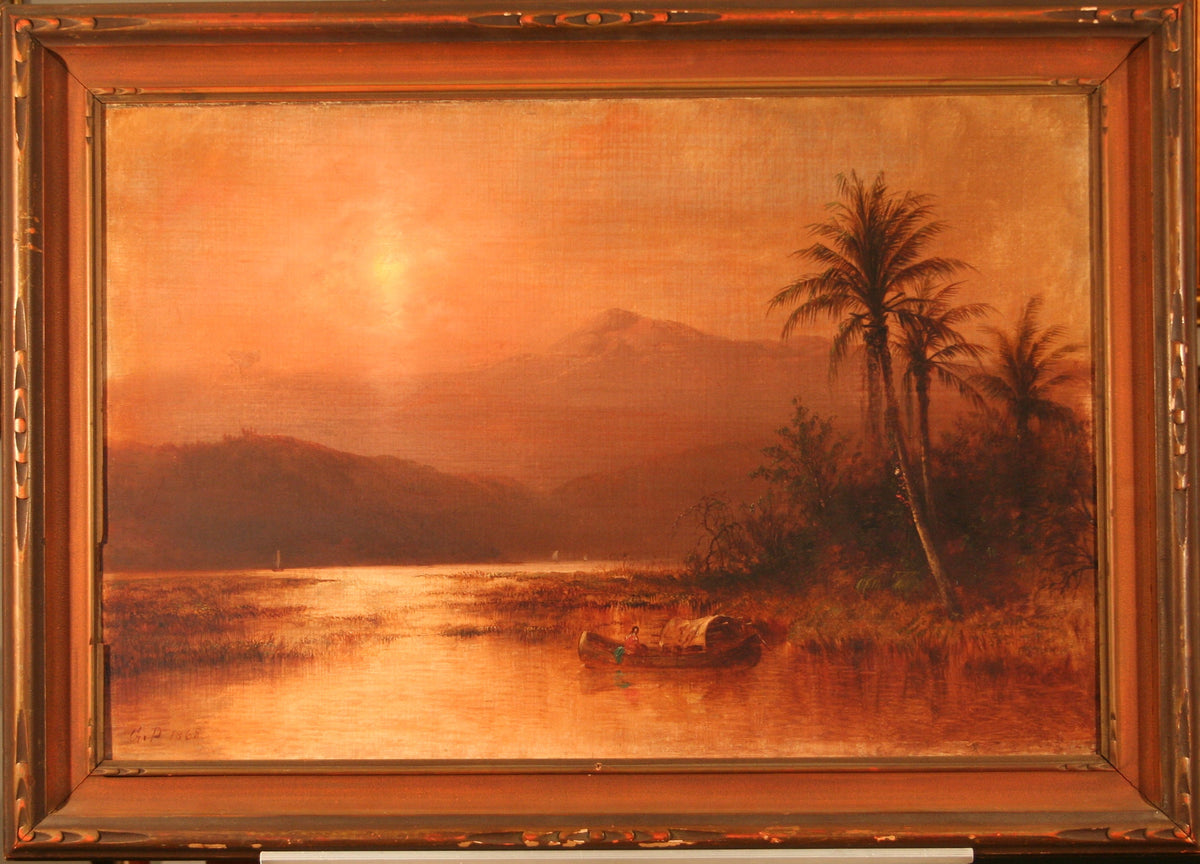
This oil on canvas by Granville Perkins, titled Central American Scene and dated 1868, presents a luminous tropical landscape bathed in the brilliant golden light of sunset. A broad expanse of calm water fills the foreground, reflecting the warm orange and amber tones of the sky. Near the shoreline, a small boat carrying figures rests upon the glowing water, providing an intimate human presence within the expansive landscape. Towering palm trees and dense tropical vegetation frame the composition at the right, while a distant mountain range rises through the atmospheric haze beyond the water.
Particularly striking is Perkins's treatment of light and atmosphere. The setting sun seems to dissolve the distinction between sky and water, enveloping the entire landscape in warm, radiant color. Small sailing vessels visible in the distance emphasize the scale and depth of the scene, while the silhouetted palms and vegetation provide a dramatic counterpoint to the brilliant sky. Measuring 20 x 29½ inches, the painting's horizontal format allows Perkins to create an expansive sense of distance and captures the exotic beauty of the tropical landscape that fascinated him throughout his career.
Monogrammed “G.P.” by the artist in the lower left corner.
Dated 1868.
Oil on canvas.
Size: 20 x 29½ inches.
Granville Perkins (1830–1895) was an accomplished nineteenth-century American landscape and marine painter, illustrator, and watercolorist particularly admired for his views of tropical America and the Caribbean. Born in Baltimore, Maryland, Perkins began his artistic career at an unusually young age as a theatrical scene painter. He later studied with noted marine painter James Hamilton at the Pennsylvania Academy of the Fine Arts in Philadelphia.
Between 1851 and 1856, Perkins traveled extensively with the Ravel theatrical company through Cuba, Jamaica, the Yucatán Peninsula, and Central America. The landscapes and tropical scenery he encountered during these journeys had a lasting influence on his art and provided subjects to which he repeatedly returned. In 1856, he exhibited Cape Croix, Cuba, a work inspired by these travels, at the Pennsylvania Academy of the Fine Arts.
By 1860, Perkins had settled in New York, where he became both a successful painter and a prolific illustrator. He was a frequent exhibitor at the National Academy of Design from 1862 through 1883, placing him within the established New York art community of the period. His illustrations appeared in important nineteenth-century publications, and his landscape drawings were reproduced in William Cullen Bryant's monumental Picturesque America, one of the most celebrated illustrated publications devoted to the American landscape.
Perkins continued traveling throughout his career, painting landscapes and marine subjects along the American East Coast as well as scenes inspired by Latin America. His ability to work successfully in oil and watercolor, together with his experience as an illustrator, contributed to the clarity and strong compositional structure of his paintings. His tropical landscapes are especially distinctive for their palms, distant mountains, broad waterways, and dramatic effects of sunlight and atmosphere.
Painted in 1868, Central American Scene is an especially appealing example of Perkins's fascination with the tropical landscape. Its glowing sunset, distant mountains, palm-lined shore, tranquil water, and small boat with figures combine to create an exotic and romantic vision rooted in the artist's own extensive travels through Central America and the Caribbean.