Gallery 44
Emil Carlsen | Still Life - Game Bird
Emil Carlsen | Still Life - Game Bird
Inquire For Price
Share
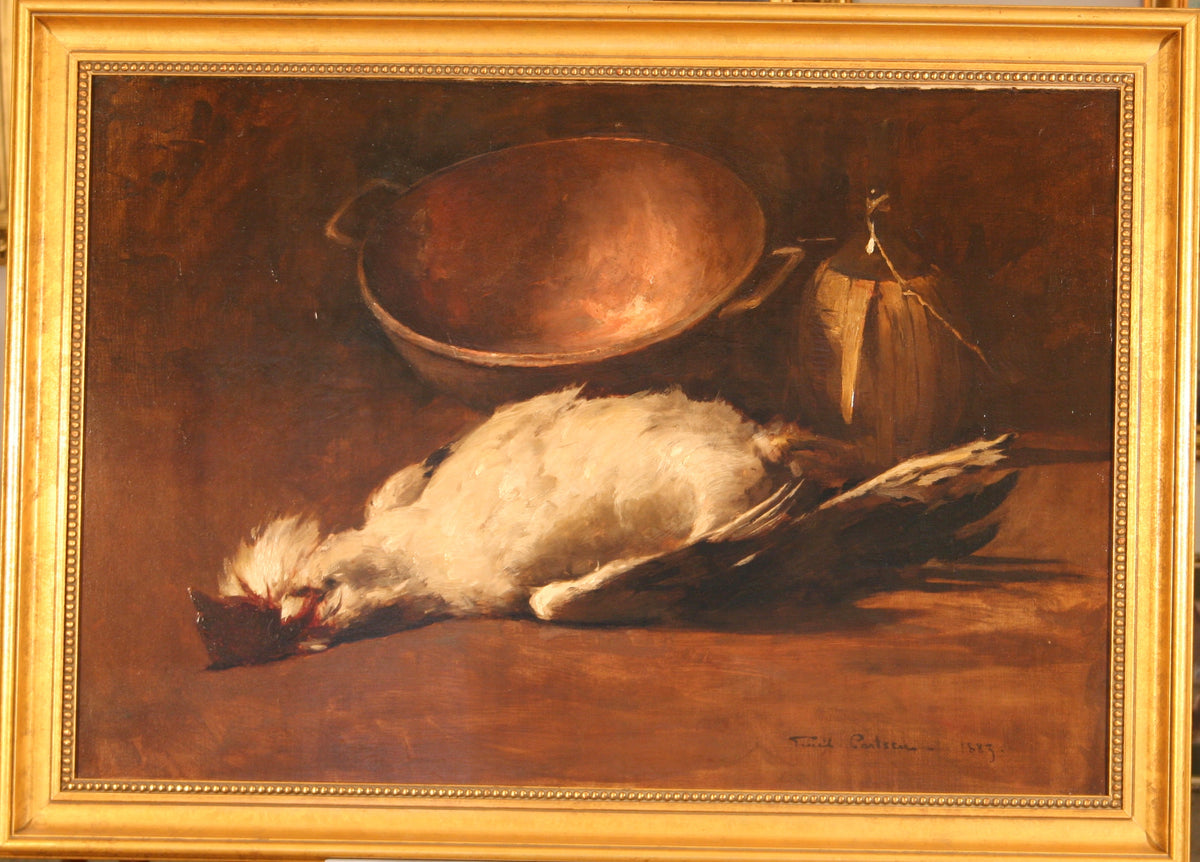
This oil on canvas by Emil Carlsen, titled Still Life – Game Bird and dated 1883, presents a striking early still life centered upon a white game bird dramatically arranged against a dark, restrained setting. The bird's predominantly white plumage, accented by dark feathers at the extremities, creates a strong visual contrast with the surrounding objects. Behind the bird, a warm copper vessel and a tall cylindrical container introduce variations of shape, texture, and reflected light. Carlsen's carefully balanced arrangement transforms these simple objects into a sophisticated study of form, color, surface, and light. The juxtaposition of soft white feathers, gleaming metal, and deep shadow is particularly characteristic of the game and kitchen still lifes that established Carlsen's early reputation.
Signed and dated 1883 by the artist in the lower right corner.
Oil on canvas.
Emil Carlsen (1853–1932) was a Danish-born American painter and one of the most highly regarded still-life artists working in America during the late nineteenth and early twentieth centuries. Born in Copenhagen, Carlsen studied architecture at the Royal Danish Academy before immigrating to the United States in 1872. He subsequently devoted himself to painting, working in Chicago, Boston, New York, San Francisco, and Paris. During his time in France, Carlsen closely studied the work of the great eighteenth-century French still-life painter Jean-Baptiste-Siméon Chardin, whose restrained compositions and masterful treatment of everyday objects became an important influence on his art.
The year 1883 marked an important turning point in Carlsen's career, when his still lifes began attracting greater recognition and he exhibited for the first time at the Pennsylvania Academy of the Fine Arts. His early compositions frequently featured dead game, copper and brass vessels, bottles, and other kitchen objects, rendered with bold contrasts of light and dark. A closely related work from the same year, Still Life: Brass Bowl, Ducks, Bottles, is in the collection of the Los Angeles County Museum of Art (LACMA) and demonstrates Carlsen's exploration of remarkably similar subject matter during this formative period.
Carlsen went on to achieve national prominence as both a painter and teacher. He taught for many years at the National Academy of Design in New York and became associated with such leading American artists as William Merritt Chase, J. Alden Weir, and Childe Hassam. His paintings were widely exhibited and received numerous awards, and his work was the subject of several one-man exhibitions at the prestigious Macbeth Gallery in New York. Today, Carlsen's paintings are represented in major American museum collections, including the National Gallery of Art, Smithsonian American Art Museum, and Los Angeles County Museum of Art, among others.
Painted in 1883, at the beginning of Carlsen's emergence as an important American still-life painter, Still Life – Game Bird is a particularly appealing early example of the dead-game subjects that would become an important part of his artistic legacy.